The plurality of expressions of the Christian faith is generating increasing interest among sociologists of religion. The variations in religious practice among Catholics, Protestants, and Orthodox Christians provide a rich field of study to understand how beliefs sharing a common root can significantly diverge in their expression and organization. This detailed study aims to decipher the theological nuances, liturgical differences, and cultural particularities that characterize these three main branches of Christianity. It highlights how history, geography, and theology have shaped distinct religious identities while preserving a common spiritual heritage.
Historical and Theological Distinctions Between Catholics, Protestants, and Orthodox Christians
The comparative table of Catholic, Protestant, and Orthodox reveals fundamental divergences arising from major historical breaks within Christianity. The schism of 1054 marked the separation of the Church into two branches: Orthodoxy, which encompasses the Eastern Churches, and Catholicism, centered around the Church of Rome. This division has both theological and political roots, crystallized around the authority of the pope and the nature of the Holy Spirit. Subsequently, Protestantism emerged in the 16th century with the Reformation initiated by figures such as Martin Luther, John Calvin, and Ulrich Zwingli, who challenged the practices and doctrines of the Catholic Church of the time.
Catholics and Orthodox Christians share a belief in apostolic tradition and the importance of sacraments, but diverge on the role of the pope, with the Catholic Church recognizing him as the supreme spiritual leader, while Orthodoxy favors a conciliar and collegial model of governance. Catholicism and Orthodoxy also differ in their approach to liturgy, with particular importance given to rites and ceremonies among the Orthodox, who see the beauty and solemnity of their worship as a manifestation of divine transcendence.
As for Protestantism, it is characterized by a great diversity of thought and practice but unites around the principle of “Sola Scriptura,” the supreme authority of the Bible in the life of the Church, and the “priesthood of all believers,” which asserts that each believer has direct access to God without the mediation of a hierarchical clergy. This biblical orientation is manifested in a simplicity of worship and a focus on the preaching of the Word. Protestant churches reject several Catholic dogmas and practices, including the veneration of saints and the veneration of Mary, although she is respected as the mother of Jesus Christ.

Religious Practices and Expressions of Faith in Catholicism, Protestantism, and Orthodoxy
Religious practices reflect the theological beliefs and historical values of the different branches of Christianity. In Catholicism, the pope occupies a central place, not only as the spiritual leader of the Roman Catholic Church but also as a figure of unity and doctrinal authority. The dogmas of the Immaculate Conception and the Assumption of Mary illustrate the particular veneration accorded to the mother of Jesus, an aspect that is manifested in prayers, liturgical feasts, and pilgrimages to sacred places dedicated to her.
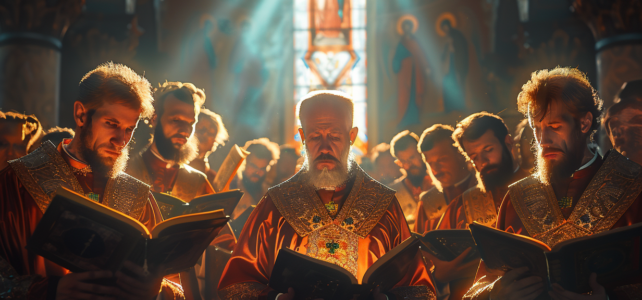
Orthodoxy, on the other hand, emphasizes the mysticism of the liturgy and the sacredness of icons. The procession of the Holy Spirit, perceived as proceeding solely from the Father, is a key element of Orthodox theology, thus distinguishing it from Catholic doctrine, which states that the Holy Spirit proceeds also from the Son. Orthodox Churches, such as the Patriarchate of Moscow, celebrate the liturgy with a solemnity and symbolic richness that is reflected in the magnificence of the churches and the depth of the rites.
Protestantism is characterized by its Bible-based approach, regarded as the only source of religious authority. The concept of priesthood of all believers abolishes distinctions between clergy and laity, allowing each believer to relate directly to God. Protestant worship services emphasize preaching and the study of Scriptures, often in a less formal setting than that of Catholic or Orthodox rites. The veneration of Mary, while respectful, does not accompany the same devotional practices as in Catholicism or Orthodoxy.
In these three major expressions of the Christian faith, we observe a variety of practices that reflect their doctrinal teachings and distinct histories. Each tradition maintains its own celebrations, ecclesiastical structures, and ways of interpreting sacred texts. This richness of diversity, while a source of historical division, is also a testimony to the common search for a connection with the divine within Christianity.