An apartment on a high floor or a rooftop terrace does not automatically provide a space shielded from prying eyes. As soon as a neighboring building exceeds the level of your home, the downward view eliminates all privacy, even behind an opaque railing. The difficulty lies in a parameter often overlooked: the vertical viewing angle, which is much harder to block than a classic horizontal line of sight.
Downward viewing angle: why classic protections are not enough
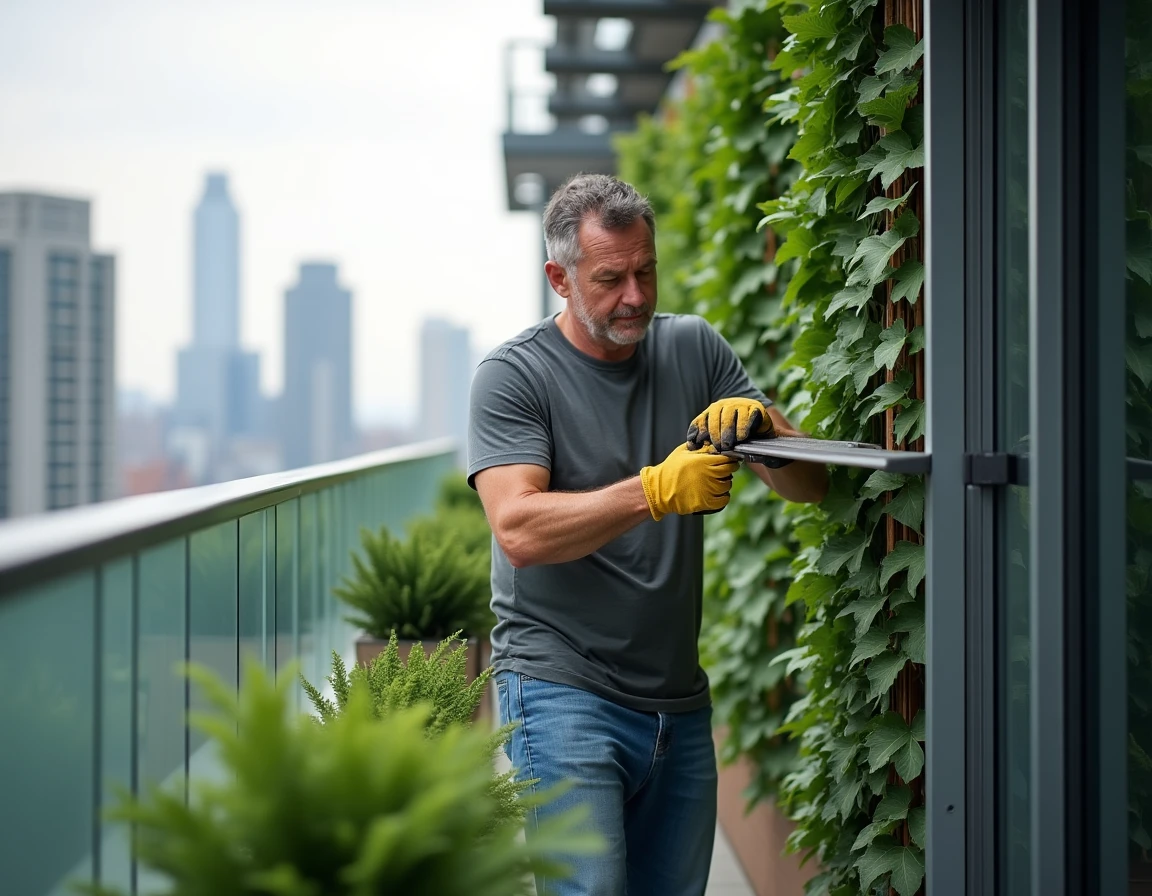
A privacy screen attached to a railing stops lateral views, those at eye level. Facing a taller building located a few dozen meters away, the gaze descends at an angle that easily passes above any standard vertical screen. A one meter seventy opaque panel, effective at ground level, barely masks anything in this configuration.
Horizontal or sloped screening then replaces vertical screening. This is the principle of a retractable awning, a pergola with adjustable slats, or a sloped shade sail: covering the area above the space to be protected to intercept the view before it reaches the ground or furniture. Several solutions allow you to protect your privacy at height by combining overhead coverage and lateral filtering.
Adjustable slat pergola and retractable awning: overhead coverage against prying eyes
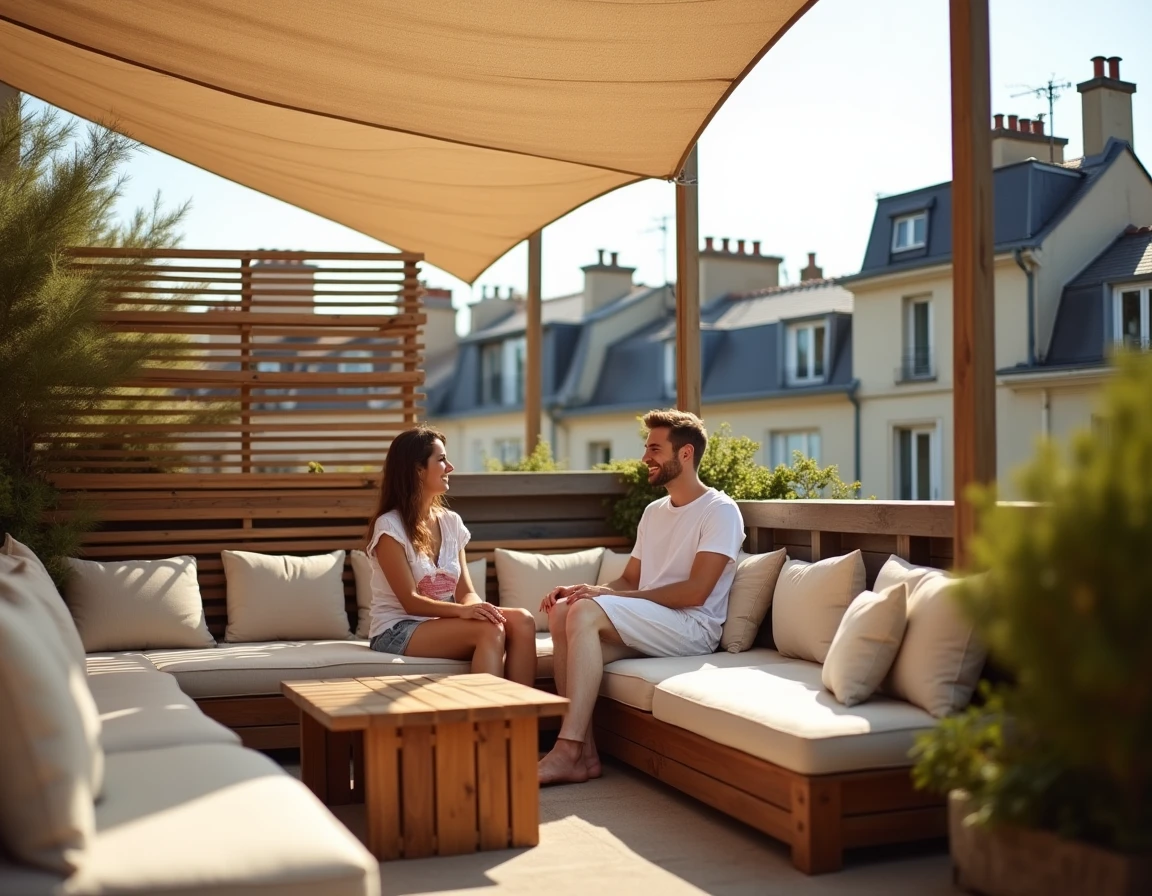
The bioclimatic pergola with adjustable slats is the most versatile response to high-level prying eyes. The slats pivot to block direct light and downward views, then reopen when privacy is no longer threatened (evening, absence of neighbors). Adjusting the angle of inclination allows for protection tailored to the exact degree of the opposing view.
The retractable awning operates on a similar principle, with fabric deployed at an angle from the facade. Its main advantage: reduced bulk when retracted. Its limitation: it only covers one axis. If the downward view comes from two directions, an awning alone leaves one side exposed.
Criteria for choosing between pergola and awning
- The pergola is suitable for wide terraces where permanent protection is desired, adjustable without manual intervention (motorization possible).
- The retractable awning is better suited for narrow balconies and facades where a fixed structure would pose a co-ownership or permit issue.
- The combination of both (awning as a lateral complement to a pergola) offers coverage on two planes, neutralizing most downward angles.
Variable opacity glazing: blocking the view without losing light
Manufacturers like Saint-Gobain (SageGlass range) and AGC Glass Europe offer electrochromic glazing capable of transitioning from transparent to translucent or opaque on demand. This technology, long reserved for offices and hotels, is expanding into high-end residential projects: penthouses, duplexes, apartments with large windows on high floors.
The principle relies on an active layer integrated into the glass. A low-intensity electric current changes the tint of the glazing in a few minutes. Natural light continues to enter, but transparency disappears. No blinds, no curtains, no loss of living space.
The cost remains significantly higher than that of standard double glazing. For mid-range budgets, the opaque adhesive film applied to existing glazing offers a compromise: it blocks the view from the outside while allowing some light to filter through. The film is not reversible on demand like electrochromic glass, but its installation requires no structural modifications.
Regulatory constraints related to downward views in co-ownership and PLU
Before installing a high structure (pergola, elevated screen, side screen), two regulatory frameworks deserve verification.
The co-ownership regulations often require validation in a general assembly for any modification visible from the outside. A retractable awning may require approval if the color or size alters the facade’s appearance. A pergola fixed to the ground of a private terrace generally falls under a prior declaration of works with the town hall.
In recent years, several municipalities in Île-de-France and major cities (Paris with the revision of the bioclimatic PLU finalized in 2023, Lyon, Bordeaux) have incorporated regulations on downward views into their PLU. These regulations may condition the issuance of a building permit on the installation of partially opaque guardrails or side screens from the building’s design stage.
Checks to conduct before works
- Consult the municipality’s PLU to identify regulations regarding the setbacks of glass doors and anti-prying devices at height.
- Read the co-ownership regulations, particularly the clauses related to special common areas (terraces, balconies, roofs).
- Check if the area of the proposed structure exceeds the threshold triggering a prior declaration or a building permit.
Vegetation solutions for high terraces and balconies
Climbing plants trained on a vertical trellis remain useful against lateral prying eyes, but against a downward gaze, they do not cover the upper plane. A potted tree with a wide crown or a climbing plant guided on an arched structure can create a partial green ceiling that mitigates the view from higher floors.
Non-invasive bamboo in pots, star jasmine, or wisteria on a lightweight pergola produce dense foliage over a limited area. The weight of the substrate and watering water is the main constraint on terraces: the load-bearing capacity of the slab must be checked before installing large volume pots.
Combining a shade sail stretched above the living space with plants around the perimeter creates a double barrier. The sail intercepts the direct view, while the foliage blurs the residual perception. This mixed approach remains the most suitable for terraces exposed to prying eyes from multiple directions.