
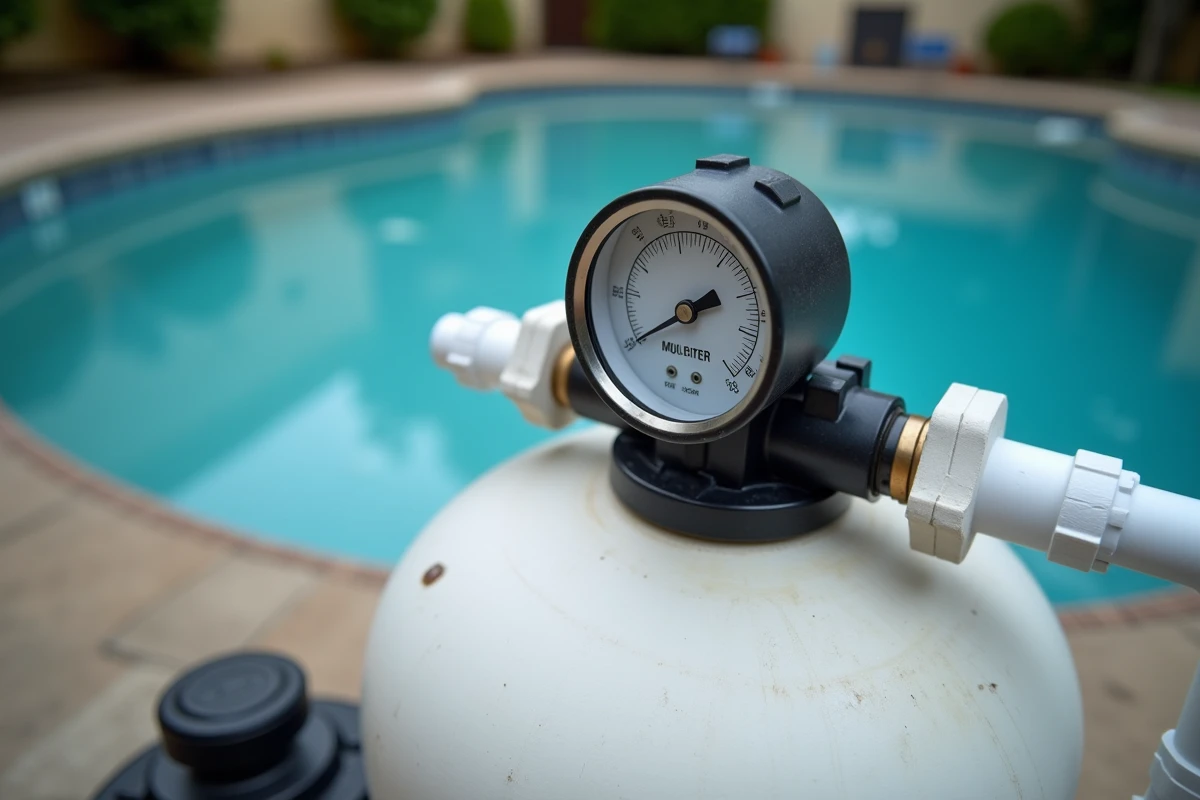
A low pressure reading on the sand filter gauge does not always indicate a filter problem. We frequently observe that the diagnosis mistakenly focuses on the tank or the sand, while the cause lies upstream, in the suction circuit or the pump itself. Understanding the hydraulic logic of the system allows for quickly eliminating false leads and addressing the correct component.
Overall hydraulic diagnosis: reading low pressure according to the discharge profile
The value displayed on the gauge is never read in isolation. It only makes sense when cross-referenced with the flow observed at the discharge nozzles. It is this cross-reading that directs the diagnosis towards the correct cause.
Low pressure with low discharge points to a flow deficit upstream of the filter. The pump is not pushing enough water through the circuit, and the gauge simply reflects this underfeeding. The sand filter is not at fault.
Low pressure with seemingly normal discharge, on the other hand, may indicate a faulty gauge. Pool gauges are fragile instruments, often exposed to the elements and chlorine. Before any investigation, we recommend testing the gauge at another pressure point or replacing it with a new model.
The third profile: pressure that continuously fluctuates between zero and a low value. This cyclical behavior almost systematically betrays an intermittent air intake in the suction circuit. Air enters in bursts, the pump partially loses its prime, and the gauge oscillates.
To learn everything about low pressure in sand filters, these three profiles serve as the starting point for any serious investigation.
Air intake in the suction circuit: the most underestimated cause
A micro-leak in the suction circuit is enough to drop the pressure on the gauge without the pump appearing to malfunction. Water circulates, the pump runs, but the actual flow is impaired by the air that infiltrates.
Air entry points to check as a priority
- The seal of the pump pre-filter cover: this is the most common leak point. A flattened, cracked, or poorly repositioned seal after cleaning the basket allows air to pass without visible water leakage when stationary.
- The suction connections between the skimmer and the pump: a loose clamp or poorly glued PVC fitting can suck in air through depression without ever leaking under pressure.
- The skimmer or bottom drain selection valve: a worn valve seal creates an air intake when the valve is in an intermediate or partially closed position.
- The water level in the pool: a level that is too low exposes the skimmer opening to air. The pump then sucks in an air-water mixture that reduces flow and pressure downstream.
The most reliable test remains observing the pre-filter basket during operation. Visible air bubbles in the pump body confirm an air intake in the suction circuit. If the basket is full of water without any bubbles, the air intake is ruled out.
Pool pump and low pressure: turbine, priming, and undersizing
When the suction circuit is airtight and the gauge is reliable, the pump becomes the main suspect. Three distinct situations cause low pressure at the filter.
Partially obstructed turbine
Fine debris (hair, swimsuit fibers, decomposed leaves) passes through the pre-filter basket and wraps around the turbine. The flow gradually decreases without abnormal noise. The pump body needs to be disassembled to inspect and clean the turbine, an operation we recommend at least once per season.
Priming issue after winterization
A pump that has not been properly re-primed after being put back into service sucks in residual air trapped in the piping. Re-priming requires manually filling the pump body before starting, then purging the air by slightly opening the upper drain plug until a continuous flow of water is achieved.
Pump undersized for the circuit
This case mainly concerns installations modified after the initial construction: adding a pressure cleaner, extending the pipes, replacing the filter with a larger diameter model. The original pump no longer provides the necessary flow to generate correct working pressure in the filter. The gauge reading remains low at all times, regardless of the condition of the sand or seals.

Clogged filter media: when the sand is truly at fault
Clogging of the sand remains a legitimate cause of malfunction, but it usually causes high pressure, not low. Low pressure related to sand occurs in a specific case: the sand is so compacted that it forms preferential channels (channeling). Water flows through these channels without encountering resistance, resulting in abnormally low pressure and ineffective filtration.
This phenomenon occurs in installations where the sand has not been changed for several years and where backwashing is insufficient or too short. The sand cements due to lime and body fats.
A chemical wash with a specific descaling product for sand filters can unclog a partially clogged filter media. If the sand forms a hard block at the surface when you dip a pole into the tank, complete replacement is the only solution. Filter glass, which is more resistant to compaction, is a sustainable alternative for installations prone to this recurring problem.
Multiport valve and internal leak: low pressure without apparent cause
The multiport valve contains a spider gasket that ensures the seal between the various internal channels. When this gasket is worn or deformed, water short-circuits the filter by passing directly from the inlet channel to the outlet channel. The pressure drops because the water no longer passes through the filter media.
The associated symptom is cloudy water despite filtration that seems to be running normally. The flow at the discharge nozzles appears correct, the pump is running, but the filter is no longer filtering. Replacing the spider gasket resolves the issue, provided the valve is disassembled and the condition of the internal diffuser is also checked.
The diagnosis of low pressure at the sand filter follows a logic of elimination: gauge, air intake, pump, multiport valve, then sand. We observe that by proceeding in this order, the majority of cases are resolved even before opening the filter tank.