
A 25 m² living room with a load-bearing wall in the middle, natural light coming in from only one side, and a poorly placed radiator: this is the kind of configuration that turns a renovation project into a puzzle. We often think that the choice of colors or the sofa will come after the work.
In reality, the decorative decisions made before the work condition the final result, and correcting a poor layout costs much more than preventing it.
Air quality and material choices: what the decorator checks before the first brushstroke
When renovating a living room, the focus is on the plaster, paint, and flooring. Decorative finishes come at the end of the chain, sometimes chosen in haste. An interior decorator incorporates a criterion that most individuals overlook: indoor air quality.
Paints, wood-derived panels, and some upholstered furniture emit volatile organic compounds. Labeling exists, but it has its limits, especially on upholstered furniture and composite panels where information remains partial. A decorator selects finishes by balancing aesthetics and safety, which avoids discovering after installation that a covering emits a persistent odor or that a new piece of furniture saturates the room.
You can request a free quote with Decoserotonine to accurately assess which materials are suitable for the configuration and volume of your living room, even before contacting a craftsman.
Living room acoustics: a functional angle that decoration can solve
A living room open to the kitchen, a high ceiling, a hard floor: reverberation turns every conversation into a cacophony. We invest in beautiful parquet or polished concrete without anticipating the acoustic effect. The decorator, however, thinks in terms of overall comfort.
Wall acoustic panels, thick curtains, long-pile rugs, and certain absorbent furniture significantly reduce echo. The performance of these elements is compared based on their absorption class, rated from A (very absorbent) to E (low absorption) according to ISO 11654. This is not a technical detail reserved for offices: in a living room equipped with a television or speaker, acoustic treatment radically changes daily comfort.
A decorator integrates these solutions without sacrificing aesthetics. A colored felt wall panel, a heavy linen curtain, or a large structured rug serve a dual purpose. You achieve a space that sounds just right, literally, without the living room resembling a recording studio.
Living room renovation and reuse: balancing style and technical feasibility
Reusing an old parquet floor, integrating a vintage dresser, or keeping existing shelves in a renovation project seems logical. Reuse reduces the budget and adds character. In practice, it’s more complicated.
- An old parquet floor may have a residual moisture content incompatible with installation on a new substrate, causing warping or cracking a few months later.
- A vintage piece of furniture may sometimes require structural reinforcement (drawer bottom, legs) to withstand daily use in a family living room.
- The flatness of the wall support must be checked before fixing heavy reclaimed elements, or you may have to redo the plaster afterward.
The decorator balances the aesthetic interest of reuse with the risk of additional costs. They know when an element is worth keeping and when it’s better to invest in something new. Without this balancing act, you end up with a floor that shifts, a shelf that twists, or a piece of furniture too fragile for the intended space.
Targeted transformation of the living room rather than complete renovation
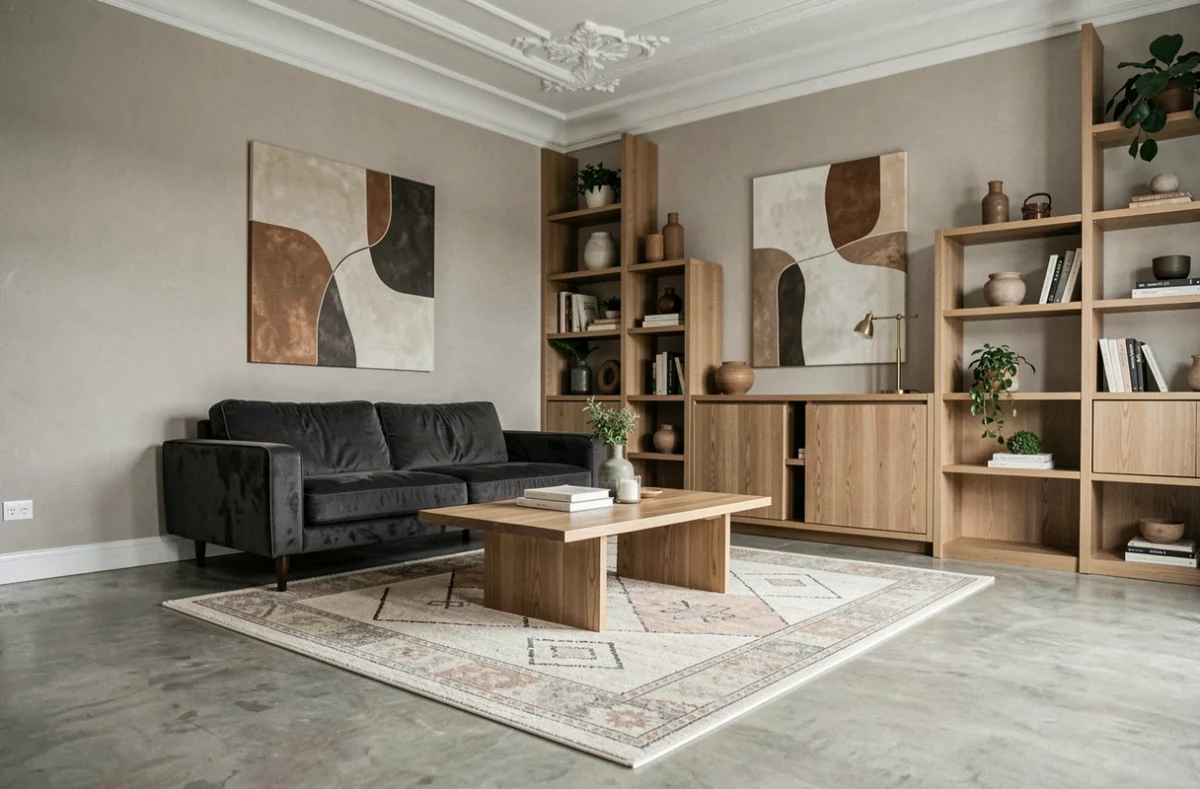
The recent trend leans towards targeted transformation rather than complete renewal of the living room. We don’t redo everything: we identify the two or three points that truly change the perception of the space.
Replacing a single ceiling light with three well-placed light sources. Repainting just one accent wall to visually restructure the room. Rearranging existing furniture to create a smooth flow. These targeted interventions cost a fraction of a total renovation and produce a comparable effect.
The decorator identifies these levers because they see the room without the habits that blind us. We have lived in our living room for years, and we no longer notice that the sofa blocks natural light or that the coffee table creates a bottleneck to the terrace. This external perspective is precisely what justifies intervention before the work, not after.
Mood boards and layout plans: envisioning before breaking down a wall
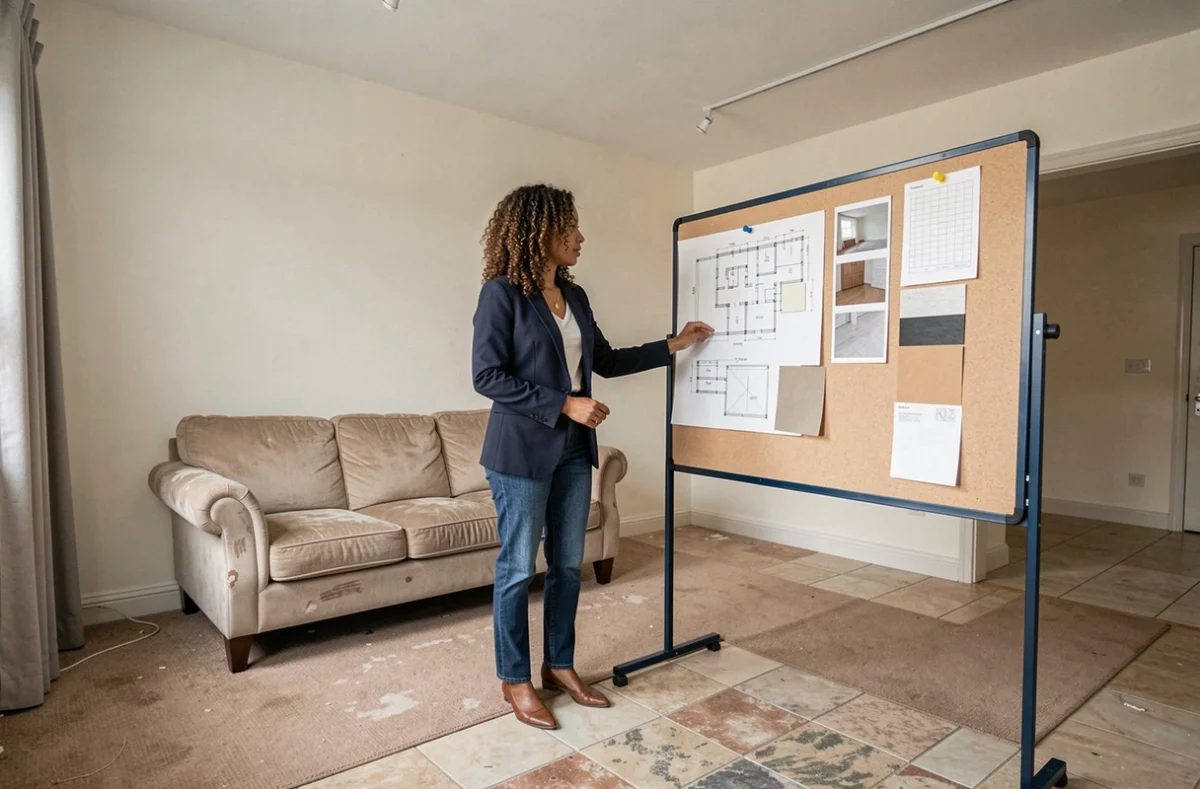
Visualizing the result before spending a single euro on work avoids regrets. A decorator produces mood boards that assemble colors, textures, furniture, and lighting into a coherent document. You can see at a glance if the sage green you imagined works with the existing oak flooring, or if the contrast is too harsh.
Layout plans allow for checking proportions. A corner sofa seems reasonable in the store, but once measured against the actual dimensions of the living room, it can take up half the usable space. Feedback on this point varies among providers, but most decorators offer at least a scaled plan and a materials board before project validation.
- The mood board aligns aesthetic choices (color palette, materials, furniture style) on a single visual support.
- The layout plan checks circulation, distances between furniture, and the placement of outlets or technical arrivals.
- The resulting specifications serve as a reference for each craftsman involved, which limits unpleasant surprises.
A renovated living room without this preparation often results in a mismatch between what was envisioned and the delivered result. Preparing the decorative project before the work protects your budget and peace of mind. The decorator does not replace the craftsman: they provide a clear framework for effective work.